Popular
Nano Banana Pro
Image1000+ prompts
View prompts
Image · Curated prompts
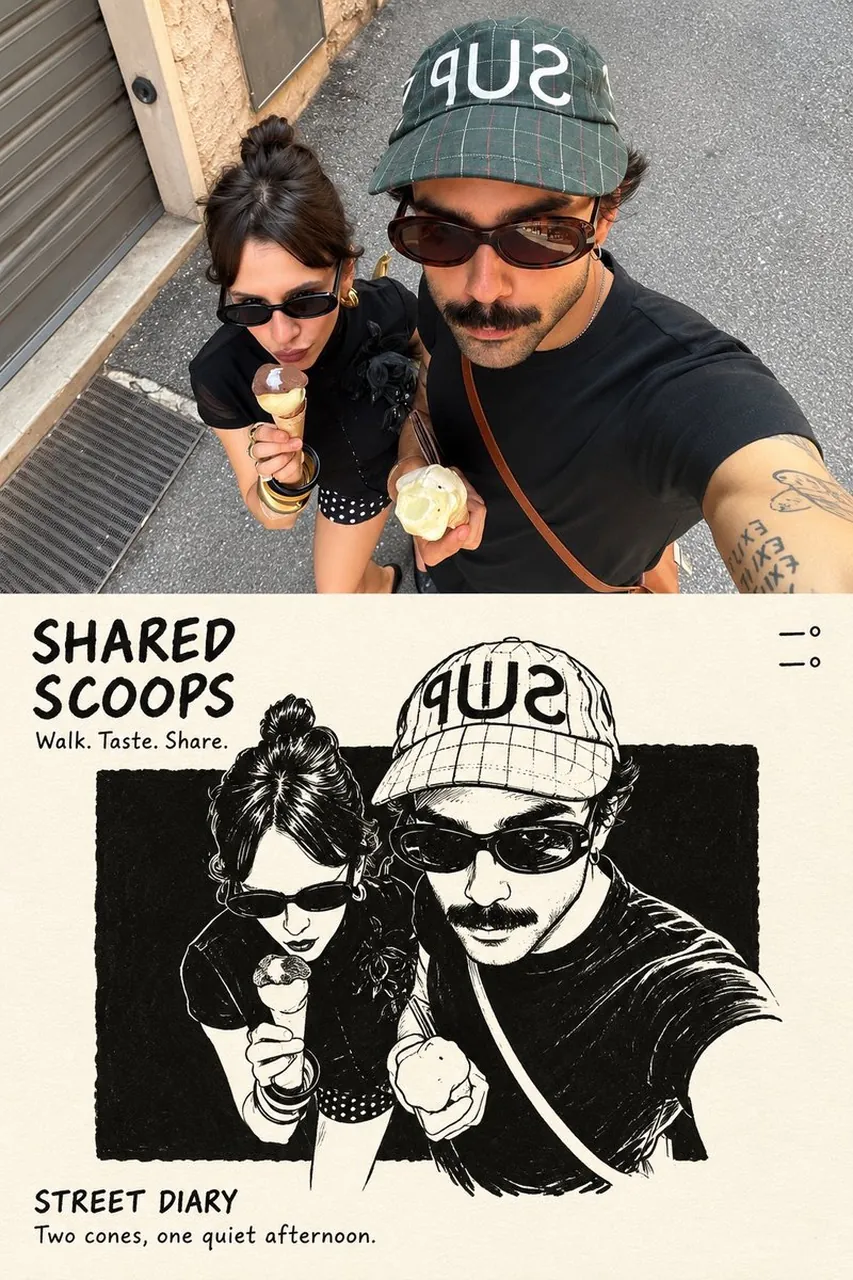
Using the uploaded reference image, create a single high-resolution vertical 2:3 editorial art poster. Divide the canvas into two perfectly equal horizontal sections, each occupying exactly 50% of the total height. Separate them with a clean, perfectly straight horizontal dividing line. 1. TOP HALF — ORIGINAL REFERENCE PHOTOGRAPH Use the uploaded reference photograph directly in the upper 50% of the poster. Preserve its original photographic quality, sharpness, natural lighting, and color relationships. Allow only subtle, intelligent cropping around the outer edges when necessary, without compromising the main subject. If required, naturally extend a small portion of the surrounding environment to fit the composition. Do not redraw, illustrate, stretch, blur, or modify the subject's appearance, structure, or spatial relationships. Do not introduce black borders, white margins, or empty edges. 2. BOTTOM HALF — MINIMALIST EDITORIAL ILLUSTRATION Use a warm, near-white ivory paper background with an extremely subtle paper texture. Analyze the main subject and visual story of the uploaded reference image. Extract only the primary subject, preserving one or two essential identifying elements. Remove or heavily simplify all secondary details, including background architecture, crowds, vehicles, fences, signs, trees, and other unnecessary elements. Transform the primary subject into a sophisticated black-ink editorial illustration. ILLUSTRATION STYLE: Use natural, clean pen strokes with varied line weight. Preserve an authentic hand-drawn appearance with expressive but controlled linework. Avoid overly precise engraving aesthetics, excessive internal details, and dense cross-hatching. Place a large, nearly pure-black rectangular ink block behind the illustrated subject. The rectangular block should have subtly imperfect, handmade print-style edges. Keep the black background clean, with only fine paper grain and minimal noise. Avoid obvious hatching, scratches, architectural lines, or complex textures. ILLUSTRATION SCALE AND COMPOSITION: The illustrated subject must occupy approximately 72–77% of the canvas width and 58–64% of the bottom section's height. Maintain a clear visual focal point with generous negative space surrounding the illustration. 3. COLOR RULES The bottom illustration must follow a strictly black-and-white color palette by default. Preserve only one localized accent color if the original reference image contains a clearly distinctive, concentrated color element with meaningful narrative importance. Ordinary blue skies, green vegetation, stone surfaces, skin tones, and environmental colors must not be treated as accent colors. Any preserved accent color must remain strictly localized to the relevant subject or area. Never allow accent colors to spread across the entire illustration. 4. TYPOGRAPHY AND EDITORIAL LAYOUT Automatically generate concise, meaningful English typography based on the content of the uploaded reference photograph. The typography must resemble handwritten editorial annotations from an independent art publication. TOP-LEFT CORNER: Generate a short handwritten title consisting of 2–5 words, arranged across two lines. Directly beneath the title, include three short English action verbs relevant to the photograph. TOP-RIGHT CORNER: Display only two lines of geographic coordinates: Latitude Longitude Do not include any additional text in this area. BOTTOM-LEFT CORNER: Display the location name followed by the word "DIARY." Directly beneath it, add one short descriptive English sentence inspired by the photograph. TYPOGRAPHY STYLE: Use a rough, upright, slightly irregular handwritten typeface. Maintain subtle imperfections and a natural editorial annotation aesthetic. Avoid elegant cursive, calligraphy, overly decorative lettering, and excessively polished typography. 5. FINAL ART DIRECTION The finished poster must combine: Authentic, high-quality photography. Minimalist black-and-white editorial illustration. Generous negative space. Independent art publication aesthetics. Quiet, restrained, sophisticated visual storytelling. Natural handwritten typography. A balanced relationship between documentary realism and expressive hand-drawn artwork. The overall result should resemble a carefully designed, collectible editorial art print. 6. FINAL OUTPUT REQUIREMENTS ASPECT RATIO: 2:3 vertical. RESOLUTION: High-resolution, sharp, print-quality output. COMPOSITION: Exactly 50% original reference photography on top. Exactly 50% editorial illustration on the bottom. One perfectly straight horizontal dividing line. One complete, standalone poster. RESTRICTIONS: No collages. No multi-poster layouts. No combined images. No unnecessary decorative elements. No modifications to the original subject's identity or appearance. No excessive illustration details. No changes to the original photograph's natural color relationships. FINAL GOAL: Create a sophisticated, visually balanced editorial art poster that faithfully preserves the uploaded reference photograph while transforming its primary subject into an expressive, minimalist black-ink illustration.
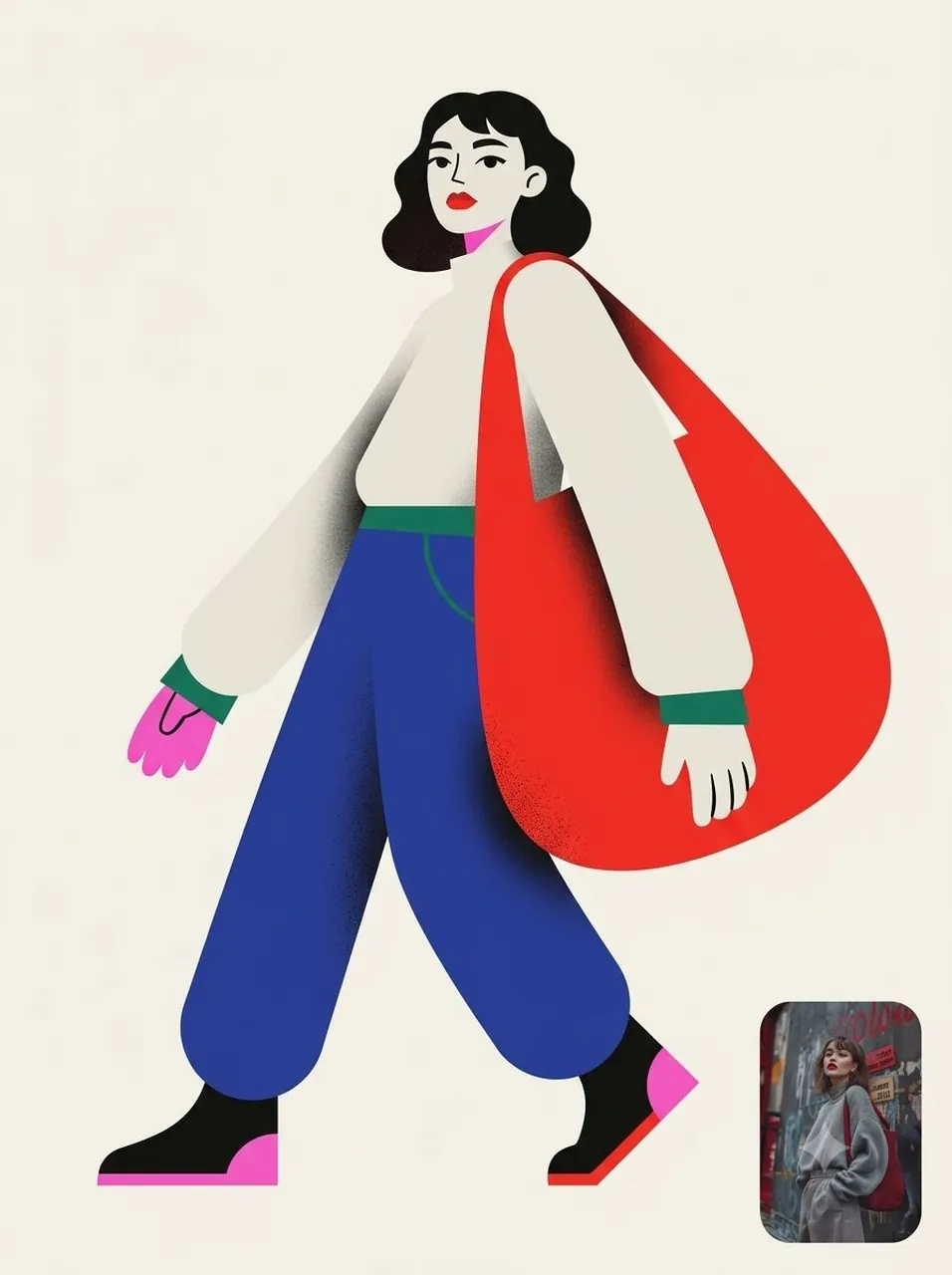
Create a finished editorial character poster inspired by the uploaded reference image. Preserve the recognizable identity, hairstyle, clothing details, pose, and important visual characteristics of the subject while translating them into a sophisticated flat geometric illustration. 3:4 VERTICAL FLAT GEOMETRIC 6-COLOUR PALETTE 01 | FORMAT LOCK Vertical 3:4 composition. Edge-to-edge warm off-white paper background. One standalone poster. Clean editorial layout. 02 | CHARACTER One adult character constructed from a few oversized asymmetric geometric shapes. Slightly exaggerated proportions, small head, elongated capsule-like limbs, simple mitten-style hands, and one oversized object integrated naturally into the pose and silhouette. Preserve the subject's recognizable appearance while simplifying details into graphic shapes. 03 | STYLE Flat geometric illustration, asymmetric proportions, crisp color blocks, soft airbrushed shading, subtle dark-to-color spray gradients where shapes overlap, fine print grain, delicate stippling mostly inside darker areas, refined contemporary editorial poster aesthetic. 04 | FACE & EXPRESSION Minimal black cut-paper facial features: simple crescent eyes and minimal mouth. The emotion should be communicated primarily through the character's full-body gesture and silhouette rather than detailed facial expression. 05 | PALETTE Warm off-white #F3F1EB, near-black #10100F, hot pink #F553D2, warm red #F42726, cobalt #293EA1, emerald #13785D. Keep colors flat and graphic with controlled soft gradients only where forms overlap. Keep the character and oversized object as the main visual focus. Use generous negative space and a balanced editorial arrangement. The object should visibly affect the overall silhouette and feel integrated into the character's pose. 06 | NEGATIVE PROMPT No extra text, logos, outlined cartoon style, glossy 3D, realistic skin, photorealism, coarse canvas texture, busy background, extra limbs, distorted anatomy, excessive facial detail, photorealistic shading, random objects, clutter, watermark. Include a small rounded picture-in-picture card in the bottom right corner displaying the original reference photo
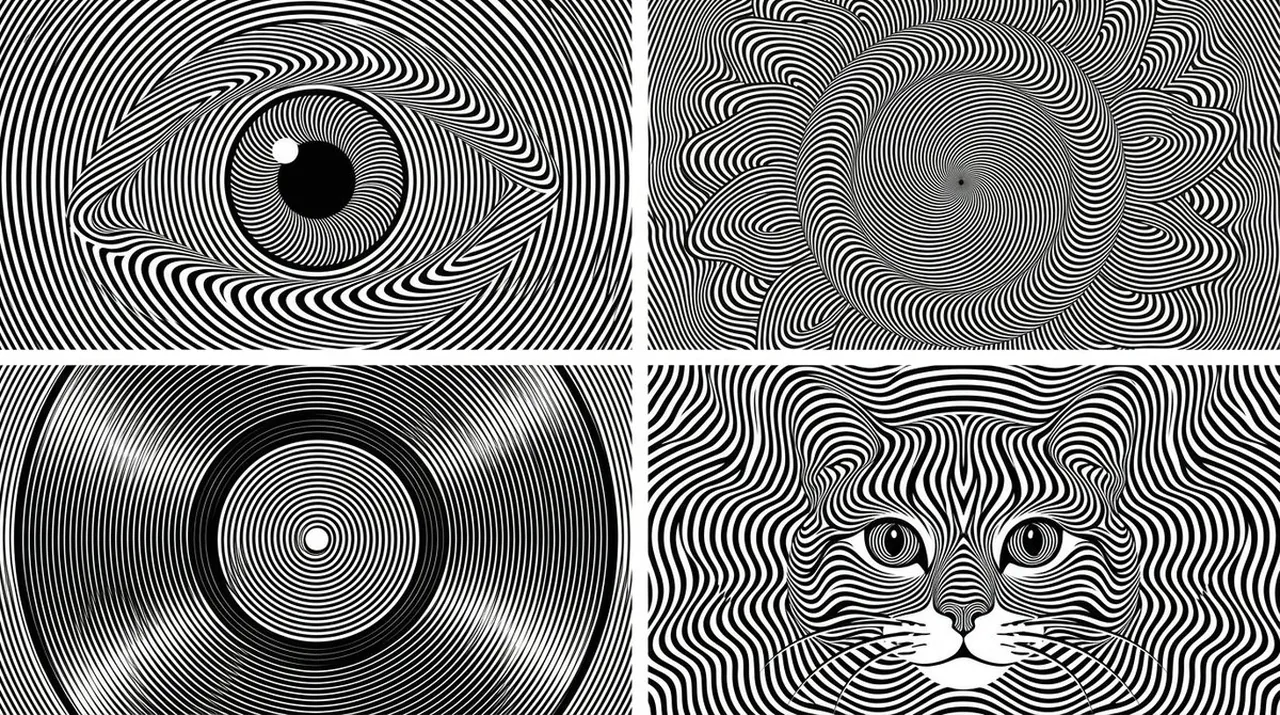
2x2 grid, 16:9 Anchor: AI picks topics (e.g., human eye / sunflower / vinyl record / cat's face) SUBJECT ::= infer_most_iconic_visual_form(TOPIC) SILHOUETTE ::= extract_primary_shape(SUBJECT) FEATURES ::= infer_recognition_critical_features(SUBJECT) FIELD_TYPE ::= choose(radial | concentric | wave | vortex | contour | hybrid) LINE_DENSITY ::= high COLOR ::= black_on_white STYLE ::= op_art + moiré + engraved contour illusion BASE_FIELD ::= generate_parallel_or_concentric_lines( spacing = uniform, thickness = constant_or_slightly_variable ) DEFORMATION_FIELD(x,y) ::= Σ influence( FEATURES, silhouette_boundary, depth_estimate, focal_points ) FINAL_LINES := warp( BASE_FIELD, vector_field = DEFORMATION_FIELD ) RULES ::= - SUBJECT must emerge only through deformation of continuous black lines - avoid conventional outlines wherever possible - contours bend, compress, expand, spiral, or redirect to reveal form - preserve uninterrupted optical rhythm across figure and background - high-information regions receive denser curvature changes - low-information regions remain smoother - negative space may define eyes, highlights, holes, or focal voids - all lines remain crisp monochrome vector-like marks - no shading except line-frequency shading - no gray fills - no hardcoded subject OBJECTIVE := maximize( topic_recognition × optical_illusion_strength × line_continuity × moire_energy × black_white_balance )
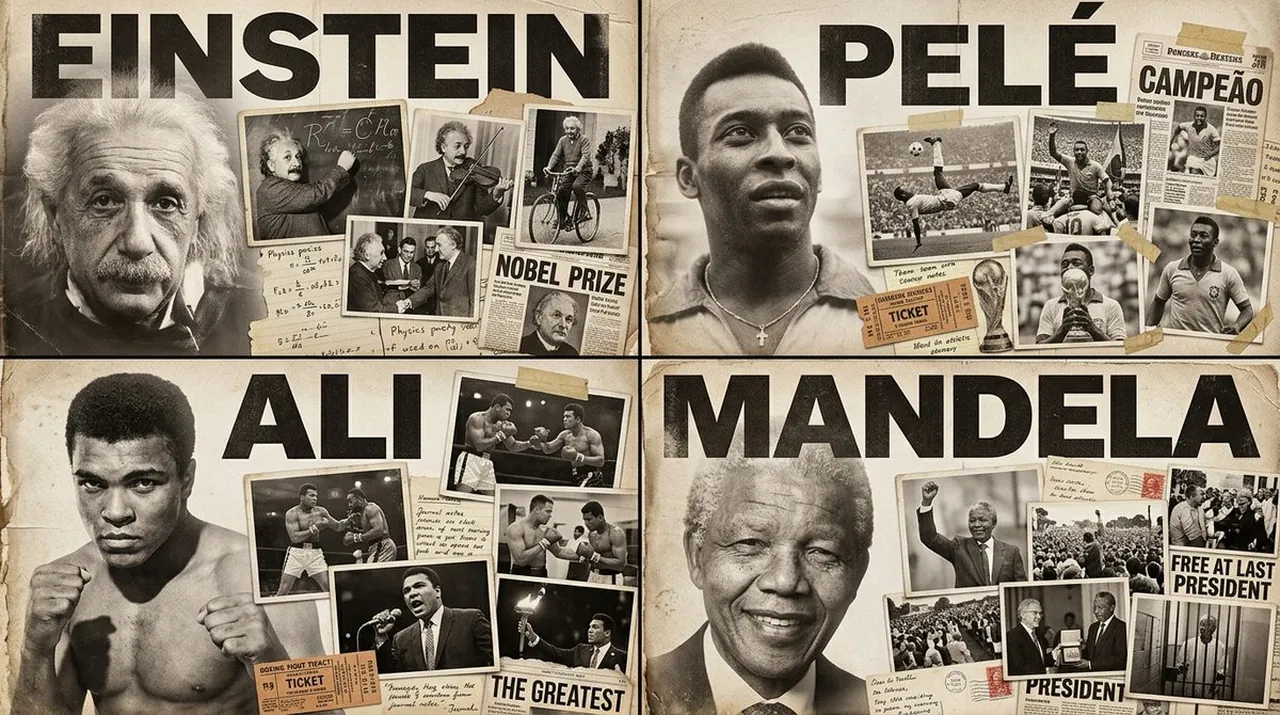
2x2 grid, 16:9. Create a documentary montage poster. Medium: Vintage silver gelatin photography, sepia tones, film grain. Layout: Overlapping cinematic collage, physical photo prints with white borders. Massive, bold, distressed sans-serif title spelling the subject's name at the top. A giant, intensely detailed, fading portrait of the subject anchoring the left side of the poster. Include 5 to 7 distinct, varying-sized rectangular photographs showing key moments, vehicles, or peers from the life of the subject. Add scrapbook elements like handwritten letters, chalkboards, or newspaper clippings related to the subject wedged between the photos. Render as a cohesive, masterpiece movie poster where the inset photos physically overlap like a scrapbook.
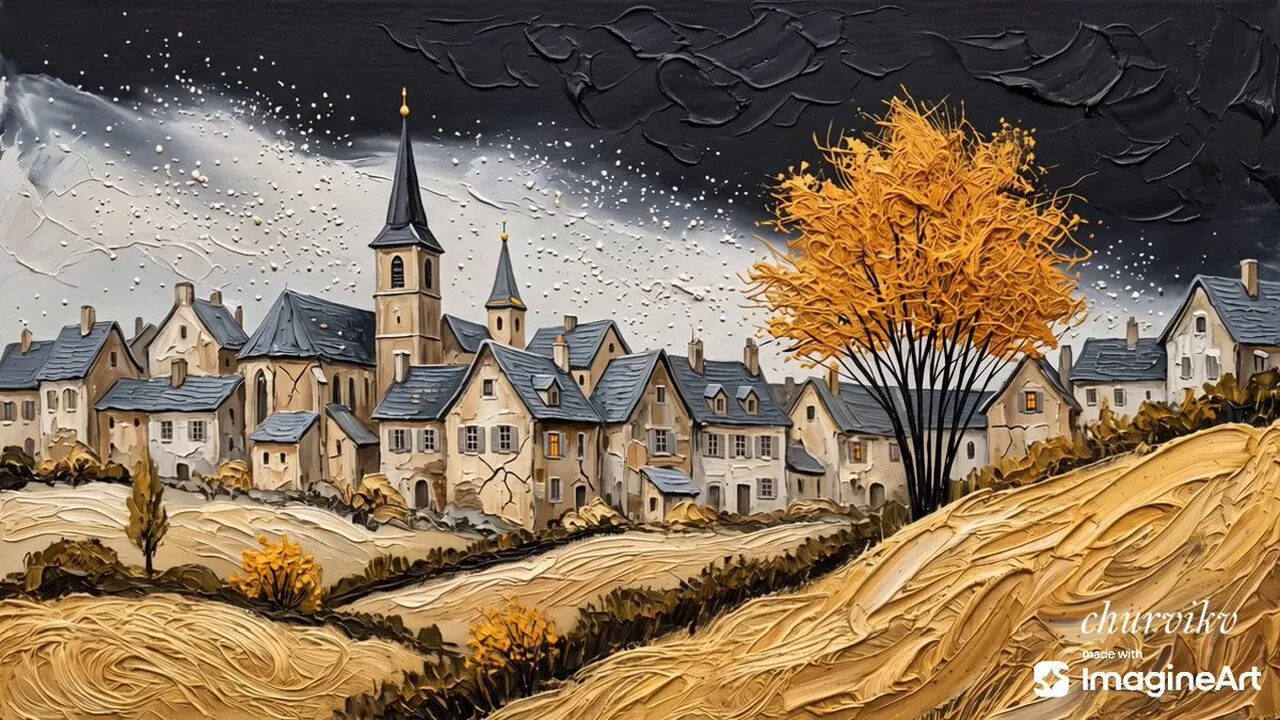
🏞: Textured impasto oil painting on coarse canvas, extremely thick sculptural palette-knife paint, wide 16:9 panoramic composition. An old European hillside village beneath a near-black sky. SKY: the upper third is deep charcoal-black, sculpted into heavy raised swirls and ridges of dark cloud. A broad diagonal band of pale grey-white cloud sweeps from the left edge down behind the rooftops, dense with countless tiny white paint specks like drifting snow or plaster dust. VILLAGE: a long dense cluster of old plaster houses spreads across the middle of the frame, in cream, tan and pale grey with steep slate-grey tiled roofs, small shuttered windows, dormers, chimneys and weathered cracked walls. A tall church tower with a dark tapered spire and small golden finial stands left of centre, with a second smaller spire tower beside it, a tiny golden ball on its cap. A few windows glow faint warm amber. TREE: right of centre, one large autumn tree in brilliant golden-orange, its canopy built from dense fine frayed stippled threads like spun straw, rising above thin black fanning branches. HILLS: rolling crests of golden straw and dry hay fill the lower third in thick swirled fibrous strokes, sweeping edge to edge. A huge golden straw slope rises into the extreme right foreground. Dark green-brown hedge rows run diagonally between the fields, with small golden bushes and one lone slender tree on the left mound. PALETTE: deep black, charcoal grey, cream, tan, slate grey, brilliant golden straw yellow. Very thick tactile ridges throughout, matte finish, decorative, calm and wintry, completely unmarked.
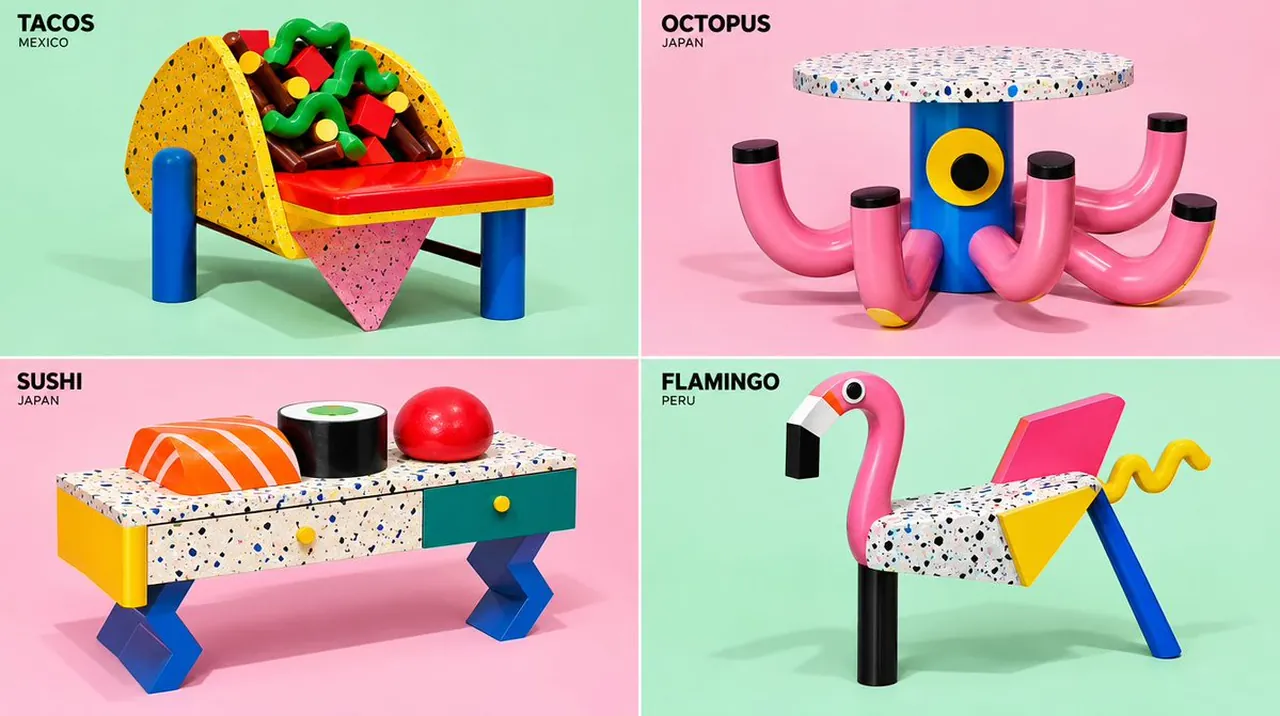
2x2 grid, do this for 4 underrated international dishes, 16:9 INPUT: [ANIMAL / MODERN GADGET / FOOD] SYSTEM: Render the input as a piece of 1980s Memphis Group designer furniture. Infer the geometric primitive logic, bold clashing colors, terrazzo patterns, and playful asymmetry. SEMANTIC SOLVE: MEMPHIS_AUTOPSY = (INFER(geometry FROM primary shapes + thick cylinders + squiggly accents + asymmetrical balance) ::5) + (INFER(materials FROM glossy laminates + speckled terrazzo + painted wood + tubular steel) ::4) + (INFER(design_psychology FROM anti-minimalism + 80s pop-art rebellion + joyful absurdity) ::4) - (muted colors + realistic object shapes + traditional woodwork) ::-4 COMPOSITION: The input completely abstracted into a bizarre but functional-looking piece of avant-garde 80s furniture. Set against a clean pastel pink or mint green studio backdrop. STYLE DNA: Ettore Sottsass design ::0.40 1980s Memphis Milano ::0.30 C4D abstract architecture ::0.20 hard studio flash photography ::0.10 OUTPUT: Bold, vibrant, structurally fascinating, crisp edges, highly graphic and shareable. NEGATIVE: no vintage grain, no messy rooms, no glowing neon, no natural organic shapes, no boring gray palettes.
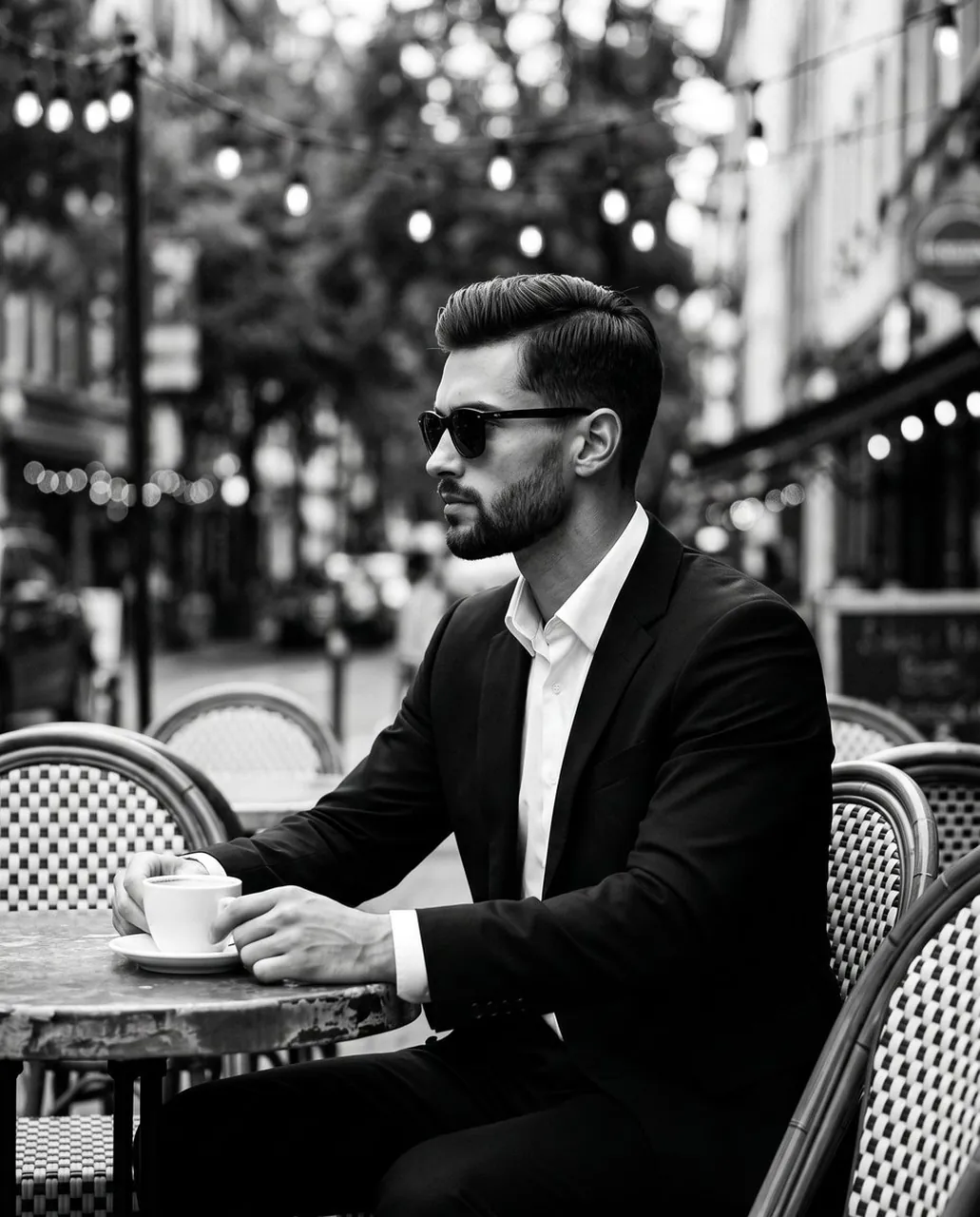
A man dressed in a sharp black suit and crisp white shirt sits positioned center-left in a strict profile view, leaning slightly forward with comfortably relaxed shoulders. His candid, serious face remains stoic with a closed, neutral mouth and relaxed eyebrows, his eyes entirely concealed behind dark sunglasses. His relaxed left hand rests naturally on the table, where his thumb and fingers lightly and organically grasp the base of a smooth white coffee cup resting on a saucer. In the immediate foreground, the worn yet smooth surface of the dominant round table offers subtle reflections, flanked on the bottom left and right by worn cafe chairs featuring distinctly woven checkered backrest patterns. Beyond this intimate foreground interaction, the spatial depth plunges into a deep, beautifully blurred outdoor cafe setting, where an out-of-focus dark gray street, a weathered gray matte building exterior, and indistinct background trees seamlessly melt away, topped by pristine string lights whose round bulbs glow softly as out-of-focus bokeh. A calm, sophisticated urban morning mood envelops the composition in a striking, high-contrast monochromatic palette dominated by rich black clothing and deep shadows, dark gray midtones, and stark white accents. Moderately directional, soft diffused natural ambient light cascades from above and slightly in front, casting short, soft-edged gray shadows beneath his chin and softly behind his back, while immaculate preserved highlights gleam precisely across his cheekbone, nose, crisp shirt collar, and the coffee cup. Executed in the clean, realistic aesthetic of classic cinematic street photography mimicking an 85mm lens at f/1.8, the digital portrait maintains tack-sharp focus on the subject against a shallow depth of field, enhanced by a black and white conversion that introduces increased contrast and a subtle, tactile film grain, all beautifully framed in a 4:5 aspect ratio.
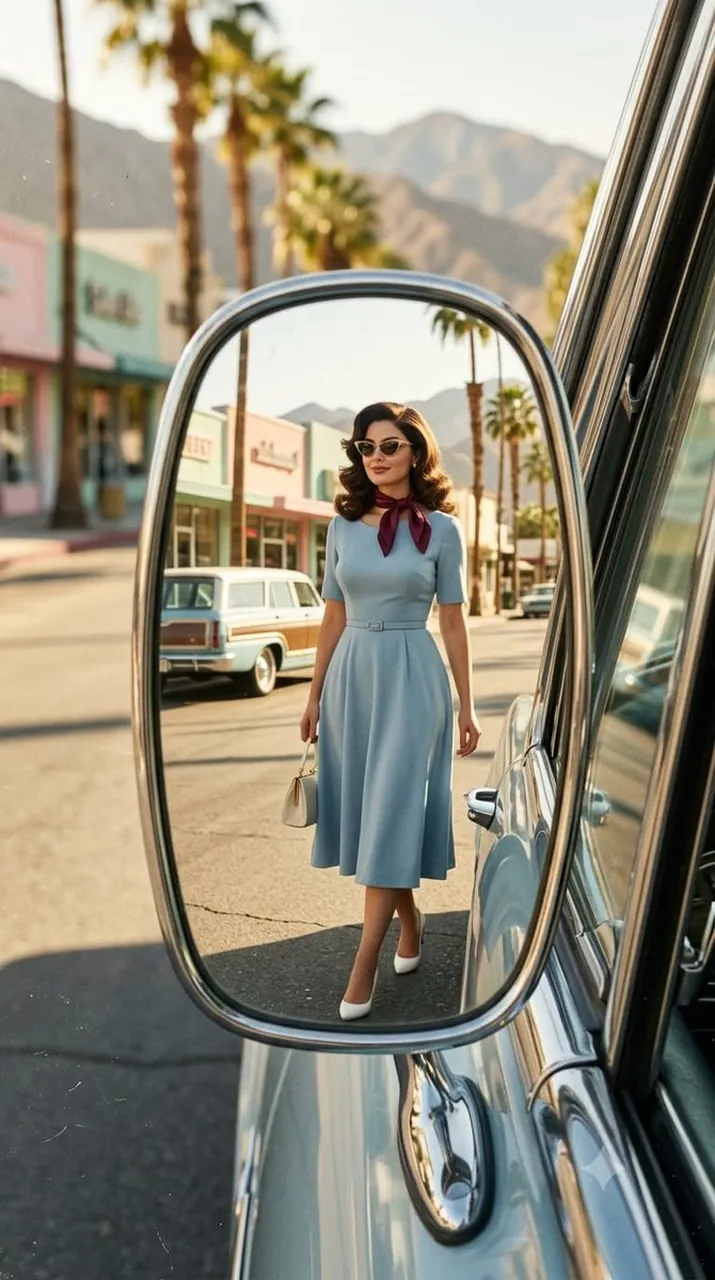
Create a hyper-realistic 1960s vintage editorial fashion photograph in a vertical 9:16 composition, featuring the girl from the reference image. Preserve her identity and appearance exactly as shown in the reference — including her facial structure, proportions, distinctive features, skin tone, hairstyle characteristics, and overall natural appearance. Do not alter or reinterpret her face. The scene is captured as a full-body fashion portrait reflected inside a small, oval chrome side mirror of a vintage car. The mirror has naturally curved, slightly distorted edges and realistic reflections. The camera is positioned close to the driver's window, angled toward the side mirror. Inside the mirror reflection, the girl is fully visible with generous background space. She is walking toward the rear of the car while slightly turning her head toward the mirror, creating a subtle candid moment. She has a calm, confident expression with a soft, understated smile. She wears a beautifully tailored powder-blue midi dress with a slim waist belt, paired with a burgundy silk scarf, elegant cat-eye sunglasses, a small ivory handbag, and classic white pointed heels. Her styling has an authentic polished 1960s fashion aesthetic. The environment is a retro Mediterranean-American street with a palm-lined road, pastel-colored storefronts, a vintage station wagon, and distant mountains. Bright golden morning sunlight creates warm, natural highlights and soft shadows across the scene. Use a refined color palette of powder blue, ivory, burgundy, and warm beige. The image should look like an authentic aged 35mm film photograph, with natural analog grain, subtle film imperfections, tiny scratches, realistic exposure, authentic skin texture, and physically accurate mirror reflections. The overall mood should feel chic, nostalgic, elegant, and slightly mysterious — like a genuine fashion editorial photograph captured in the 1960s rather than an AI-generated image. Photorealistic, cinematic, highly detailed, natural proportions, realistic fabric texture, authentic vintage photography aesthetics.
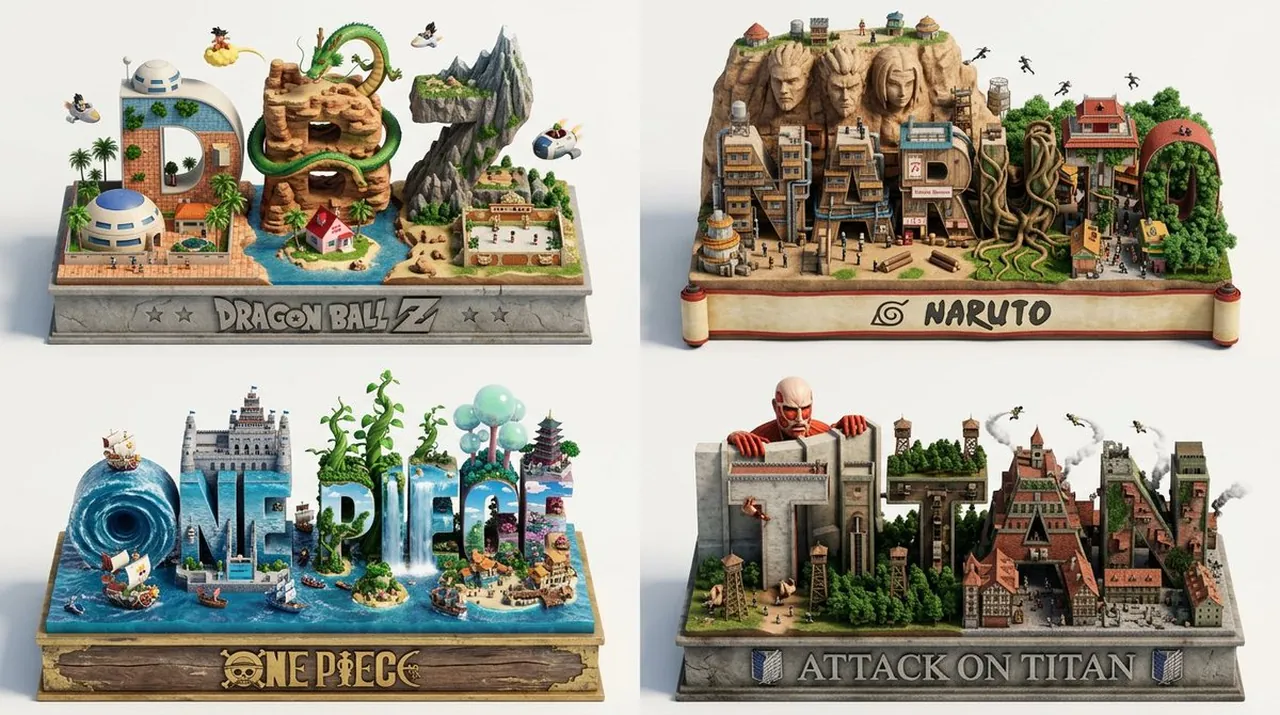
2x2 grid, 16:9, do this for 4 famous manga: Isometric 3D diorama where the word "[$WORD]" IS the landscape: each giant 3D letter is transformed into a miniature building, habitat, or scene built from the world of [$SUBJECT] (the model infers per-letter details). Tiny inhabitants and props from the subject live on and inside the letters. Reads as a word from afar, as a bustling micro-city up close. A motto on a plinth beneath. Tilt-shift, soft light, seamless white background, ultra-detailed, legible text
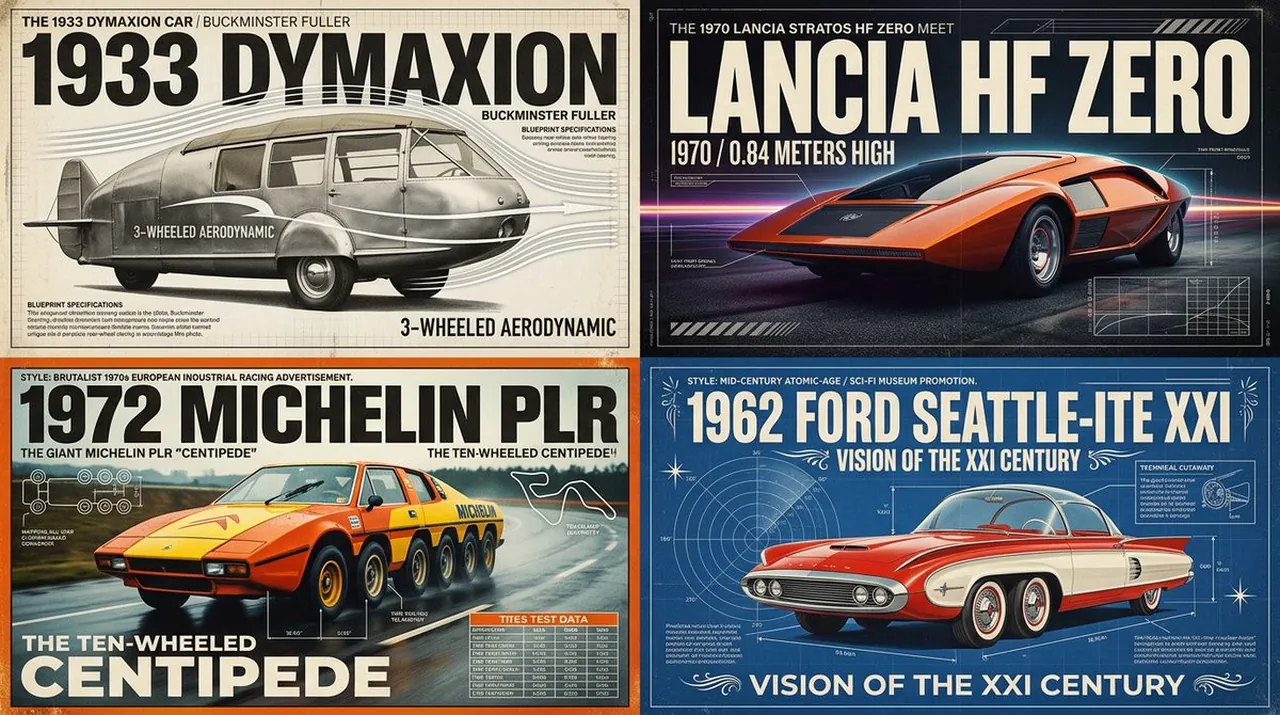
Create a premium automotive launch advertisement. You are a god-tier automotive advertising director, transportation photographer, and print-production specialist. Generate a high-end campaign asset sheet featuring a classic car. Use a combination of three distinct automotive design movements and three graphic systems, applying a 60/30/10 weighting hierarchy. Ensure the final output features professional automotive-commercial lighting, sharp body geometry, and believable print-production details. Include a compelling headline, a concise tagline, and a small campaign name. Maintain accurate vehicle proportions, wheel placement, and camera perspective. Ensure the composition is clean, avoiding malformed elements, and utilize professional negative space for a high-end aesthetic. 16:9 aspect ratio, production-ready composition.
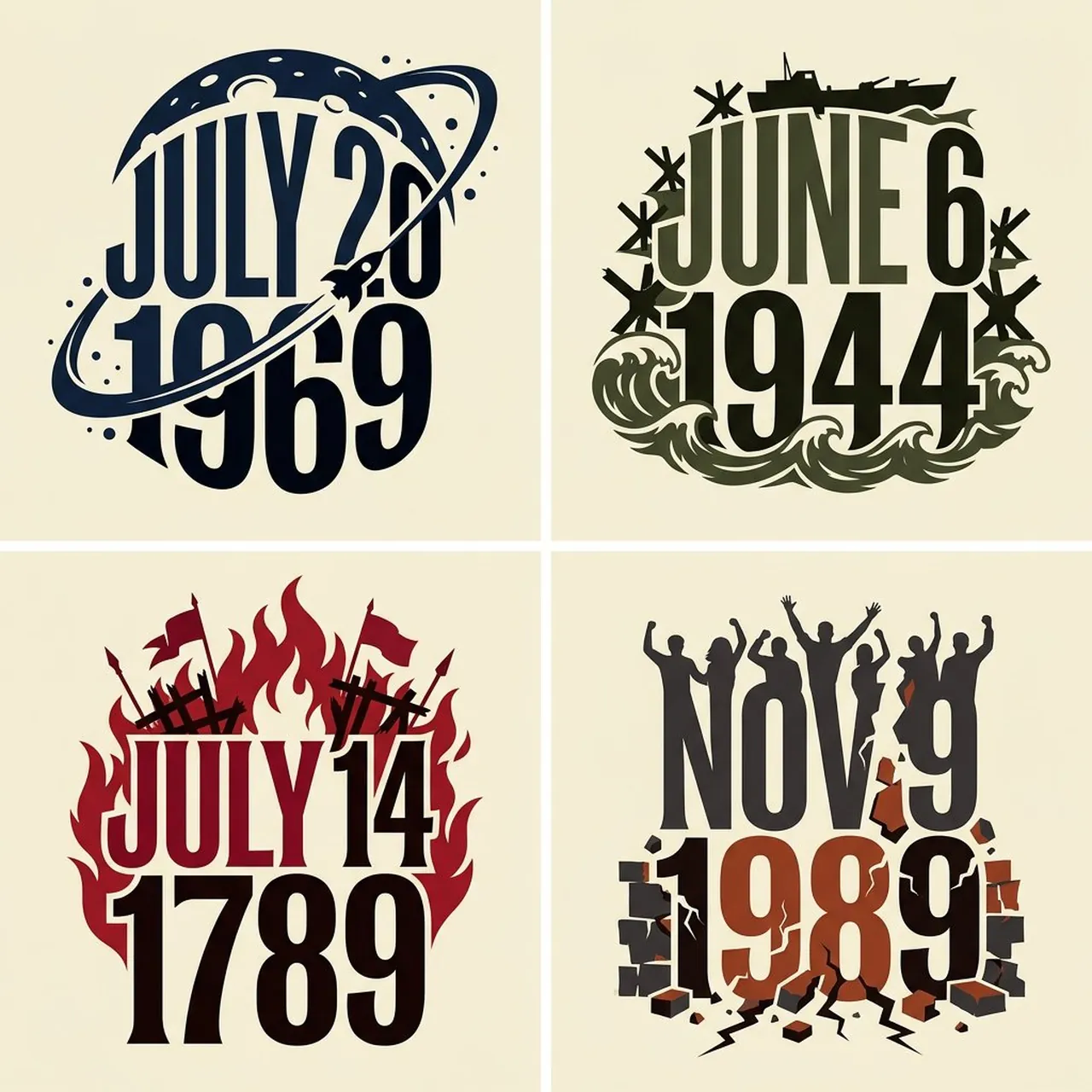
that brings out the difference between these two. 2x2 grid, do this for 4 days that changed history FORMAT: wide landscape, 16:9 Create a compact conceptual typographic artwork displaying the subject in uppercase. Combine expressive custom lettering with ONE subject-specific visual motif, forming a single unified graphic silhouette on warm ivory. DESIGN FOUNDATION — KEEP FIXED Make the word the dominant graphic structure, spanning almost the entire artwork. Draw tall, tightly fitted, high-contrast uppercase display-serif letters with exaggerated proportions: broad strokes, narrow openings, concave sides, sharp flared terminals, and stretched curves. Shape the word as a whole. Vary letter widths and heights, subtly bending the top and bottom contours to fit the surrounding motif. Keep spelling and readability intact. Render the letters as flat, solid, opaque shapes with crisp edges. Choose black, ivory, or white according to contrast. Keep letter faces untextured. CONCEPT INFERENCE — CHANGE WITH THE SUBJECT Identify the subject’s central visual quality. Translate it into ONE coherent motif and ONE organizing behavior, such as repetition, flowing expansion, compression, branching, or gradual transformation. Build the entire image by developing that motif. Choose it for its expressive shape and relationship to the subject. Express meaning through contour, rhythm, scale, spacing, and color. Do not assemble a collection of topical objects. INTEGRATION Fuse the motif with the word’s outer silhouette. Let it emerge from selected letter edges, extend above or below the lettering, and define meaningful white openings. When a human profile is appropriate, simplify it into an elegant silhouette. Let it share a boundary with the word or motif. Avoid realistic portrait detail. Keep most letter faces unobstructed. The motif should create a deliberate outer contour and a few strong internal relationships. STYLE CALIBRATION For HUMANITY: Use a sequence of overlapping human profile silhouettes, with varied contours and a progression from black through medium gray to pale gray. Arrange them rhythmically across the upper portion of the word. Integrate dark profiles into the outer ends of the composition. Keep the lettering black and the treatment restrained, predominantly flat, and monochrome. For CREATIVITY: Use one continuous system of flowing, curled, vividly colored ribbons resembling sculpted liquid pigment. Form sweeping crests, spiral tips, and fine internal grooves in cyan, deep blue, magenta, orange, and yellow. Integrate a simplified profile into the left boundary. Place large white lettering across the darker central region. Confine smooth shading and highlights to the colored curls. For other subjects: Infer an equally economical motif and treatment. Preserve the same custom typography, unified silhouette, clean background, and limited visual vocabulary. Do not automatically repeat faces or colorful ribbons. DETAIL AND DEPTH Use clean silhouette edges and broad readable shapes. Concentrate fine detail inside the chosen motif. Any shading should describe the motif’s local curvature. Keep the overall work a graphic illustration without a camera perspective, staged environment, or physical pedestal. EXCLUSIONS No miniature worlds, buildings, landscapes, crowds, realistic heads, floating symbolic objects, prop collections, or scenes inside letters. No stone lettering, metallic lettering, beveled text, extruded letter blocks, cast shadows, distressed surfaces, or cinematic lighting. COMPOSITION Center the complete artwork with clear ivory margins. Keep its outer shape compact and intentional. At thumbnail size, the viewer should immediately perceive the word and one visual idea. Remove anything that competes with those two readings. Output one finished artwork containing only the subject word.
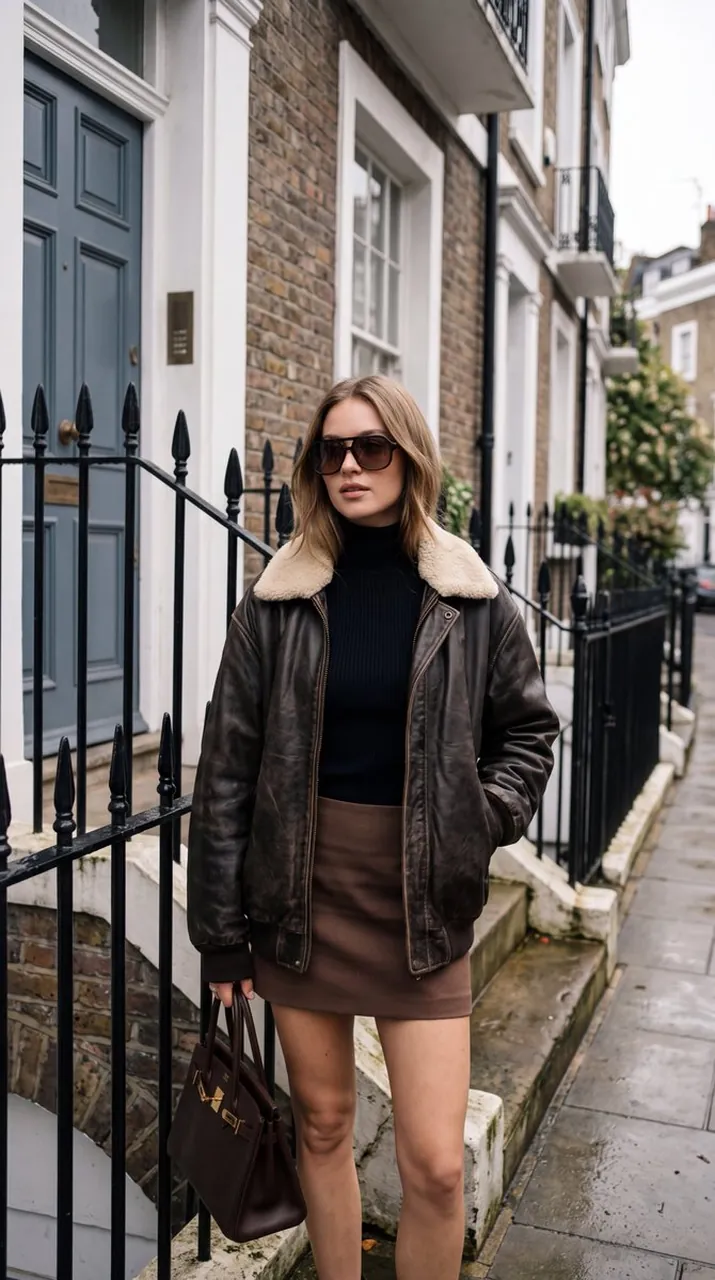
Use the reference image as the exact identity reference. Preserve the subject’s facial identity, facial proportions, hairstyle, body proportions and natural appearance. Create a photorealistic high-fashion street-style photograph in London. The subject is standing outside a classic British townhouse with a muted blue-gray paneled door and black wrought-iron railings. She wears a fitted black ribbed turtleneck, oversized dark brown vintage leather jacket with a soft shearling collar, brown mini skirt, and carries a structured dark brown leather handbag with gold hardware. Oversized dark sunglasses, minimal makeup, effortless model-off-duty expression. Overcast natural daylight, muted neutral color palette, realistic shadows, authentic leather texture, subtle film grain, editorial fashion photography, candid street photography, 50mm lens, shallow depth of field, extremely photorealistic, no text, no watermark.
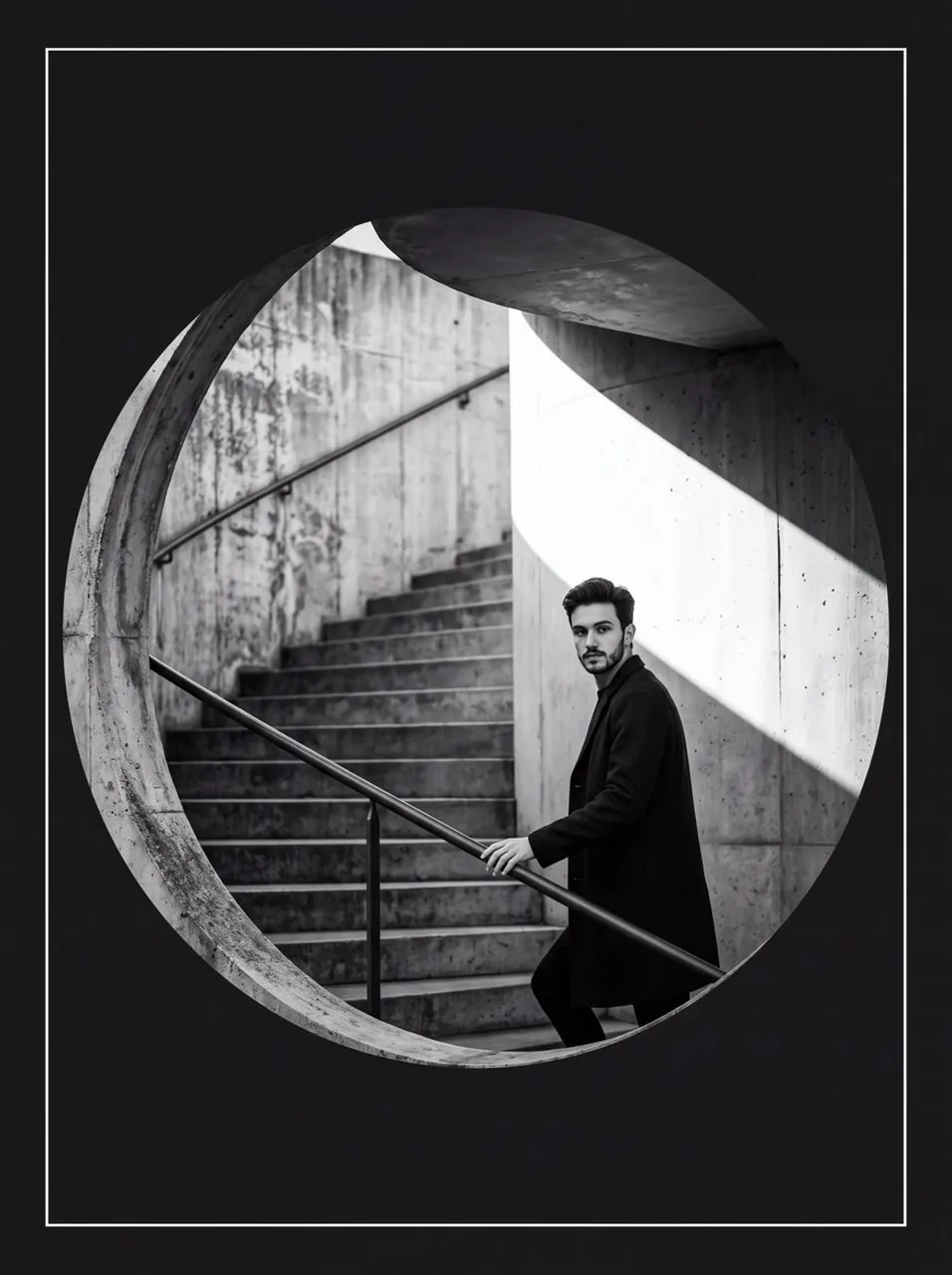
Black and white fine-art architectural portrait photography, vertical 4:5 portrait format. A perfectly circular porthole-shaped cutout reveals a brutalist concrete stairwell, while everything outside the circle is flat, solid near-black charcoal (#161616), with a thin crisp white rectangular border line inset a few millimeters from the frame edge. The circle sits slightly above center, with the thick, weathered concrete ring edge visible on the left side. Inside the circle: wide concrete steps rising diagonally from left to right, a slim dark metal handrail running parallel along the diagonal, a large curved concrete wall on the right catching a hard shaft of direct sunlight that creates a bright white diagonal shape, a dark curved ceiling overhang at the top right, and rough concrete texture on the left wall. Extremely high contrast, deep crushed blacks, bright highlights, strong geometric lines and curves. A lone man is walking up the stairs in the lower right of the circle, caught mid-step, one hand lightly sliding along the metal handrail. His body is angled up the staircase, but his head is turned and he looks directly into the camera lens, making strong eye contact with the viewer. He is clearly visible, not a silhouette: bareheaded with short dark hair, no hat, no cap, wearing a dark long coat, face lit by the sunbeam on one side, with a calm, serious expression. His face is the sharpest point in the image, with crisp eyes, skin texture, and defined jawline, in razor-sharp focus. Shot on an 85mm f/1.4 portrait lens, shallow depth of field, the stairs, handrail, and concrete walls behind and in front of him fall into a soft, creamy blur, with gentle compression of the stairwell geometry. Moody, minimalist, cinematic, fine film grain, no color, no text.
Discover the prompts creators are using and loving most.
Most used
Using the uploaded reference image, create a single high-resolution vertical 2:3 editorial art poster. Divide the canvas into two perfectly equal horizontal sections, each occupying exactly 50% of the total height. Separate them with a clean, perfectly straight horizontal dividing line. 1. TOP HALF — ORIGINAL REFERENCE PHOTOGRAPH Use the uploaded reference photograph directly in the upper 50% of the poster. Preserve its original photographic quality, sharpness, natural lighting, and color relationships. Allow only subtle, intelligent cropping around the outer edges when necessary, without compromising the main subject. If required, naturally extend a small portion of the surrounding environment to fit the composition. Do not redraw, illustrate, stretch, blur, or modify the subject's appearance, structure, or spatial relationships. Do not introduce black borders, white margins, or empty edges. 2. BOTTOM HALF — MINIMALIST EDITORIAL ILLUSTRATION Use a warm, near-white ivory paper background with an extremely subtle paper texture. Analyze the main subject and visual story of the uploaded reference image. Extract only the primary subject, preserving one or two essential identifying elements. Remove or heavily simplify all secondary details, including background architecture, crowds, vehicles, fences, signs, trees, and other unnecessary elements. Transform the primary subject into a sophisticated black-ink editorial illustration. ILLUSTRATION STYLE: Use natural, clean pen strokes with varied line weight. Preserve an authentic hand-drawn appearance with expressive but controlled linework. Avoid overly precise engraving aesthetics, excessive internal details, and dense cross-hatching. Place a large, nearly pure-black rectangular ink block behind the illustrated subject. The rectangular block should have subtly imperfect, handmade print-style edges. Keep the black background clean, with only fine paper grain and minimal noise. Avoid obvious hatching, scratches, architectural lines, or complex textures. ILLUSTRATION SCALE AND COMPOSITION: The illustrated subject must occupy approximately 72–77% of the canvas width and 58–64% of the bottom section's height. Maintain a clear visual focal point with generous negative space surrounding the illustration. 3. COLOR RULES The bottom illustration must follow a strictly black-and-white color palette by default. Preserve only one localized accent color if the original reference image contains a clearly distinctive, concentrated color element with meaningful narrative importance. Ordinary blue skies, green vegetation, stone surfaces, skin tones, and environmental colors must not be treated as accent colors. Any preserved accent color must remain strictly localized to the relevant subject or area. Never allow accent colors to spread across the entire illustration. 4. TYPOGRAPHY AND EDITORIAL LAYOUT Automatically generate concise, meaningful English typography based on the content of the uploaded reference photograph. The typography must resemble handwritten editorial annotations from an independent art publication. TOP-LEFT CORNER: Generate a short handwritten title consisting of 2–5 words, arranged across two lines. Directly beneath the title, include three short English action verbs relevant to the photograph. TOP-RIGHT CORNER: Display only two lines of geographic coordinates: Latitude Longitude Do not include any additional text in this area. BOTTOM-LEFT CORNER: Display the location name followed by the word "DIARY." Directly beneath it, add one short descriptive English sentence inspired by the photograph. TYPOGRAPHY STYLE: Use a rough, upright, slightly irregular handwritten typeface. Maintain subtle imperfections and a natural editorial annotation aesthetic. Avoid elegant cursive, calligraphy, overly decorative lettering, and excessively polished typography. 5. FINAL ART DIRECTION The finished poster must combine: Authentic, high-quality photography. Minimalist black-and-white editorial illustration. Generous negative space. Independent art publication aesthetics. Quiet, restrained, sophisticated visual storytelling. Natural handwritten typography. A balanced relationship between documentary realism and expressive hand-drawn artwork. The overall result should resemble a carefully designed, collectible editorial art print. 6. FINAL OUTPUT REQUIREMENTS ASPECT RATIO: 2:3 vertical. RESOLUTION: High-resolution, sharp, print-quality output. COMPOSITION: Exactly 50% original reference photography on top. Exactly 50% editorial illustration on the bottom. One perfectly straight horizontal dividing line. One complete, standalone poster. RESTRICTIONS: No collages. No multi-poster layouts. No combined images. No unnecessary decorative elements. No modifications to the original subject's identity or appearance. No excessive illustration details. No changes to the original photograph's natural color relationships. FINAL GOAL: Create a sophisticated, visually balanced editorial art poster that faithfully preserves the uploaded reference photograph while transforming its primary subject into an expressive, minimalist black-ink illustration.
Create a finished editorial character poster inspired by the uploaded reference image. Preserve the recognizable identity, hairstyle, clothing details, pose, and important visual characteristics of the subject while translating them into a sophisticated flat geometric illustration. 3:4 VERTICAL FLAT GEOMETRIC 6-COLOUR PALETTE 01 | FORMAT LOCK Vertical 3:4 composition. Edge-to-edge warm off-white paper background. One standalone poster. Clean editorial layout. 02 | CHARACTER One adult character constructed from a few oversized asymmetric geometric shapes. Slightly exaggerated proportions, small head, elongated capsule-like limbs, simple mitten-style hands, and one oversized object integrated naturally into the pose and silhouette. Preserve the subject's recognizable appearance while simplifying details into graphic shapes. 03 | STYLE Flat geometric illustration, asymmetric proportions, crisp color blocks, soft airbrushed shading, subtle dark-to-color spray gradients where shapes overlap, fine print grain, delicate stippling mostly inside darker areas, refined contemporary editorial poster aesthetic. 04 | FACE & EXPRESSION Minimal black cut-paper facial features: simple crescent eyes and minimal mouth. The emotion should be communicated primarily through the character's full-body gesture and silhouette rather than detailed facial expression. 05 | PALETTE Warm off-white #F3F1EB, near-black #10100F, hot pink #F553D2, warm red #F42726, cobalt #293EA1, emerald #13785D. Keep colors flat and graphic with controlled soft gradients only where forms overlap. Keep the character and oversized object as the main visual focus. Use generous negative space and a balanced editorial arrangement. The object should visibly affect the overall silhouette and feel integrated into the character's pose. 06 | NEGATIVE PROMPT No extra text, logos, outlined cartoon style, glossy 3D, realistic skin, photorealism, coarse canvas texture, busy background, extra limbs, distorted anatomy, excessive facial detail, photorealistic shading, random objects, clutter, watermark. Include a small rounded picture-in-picture card in the bottom right corner displaying the original reference photo
2x2 grid, 16:9 Anchor: AI picks topics (e.g., human eye / sunflower / vinyl record / cat's face) SUBJECT ::= infer_most_iconic_visual_form(TOPIC) SILHOUETTE ::= extract_primary_shape(SUBJECT) FEATURES ::= infer_recognition_critical_features(SUBJECT) FIELD_TYPE ::= choose(radial | concentric | wave | vortex | contour | hybrid) LINE_DENSITY ::= high COLOR ::= black_on_white STYLE ::= op_art + moiré + engraved contour illusion BASE_FIELD ::= generate_parallel_or_concentric_lines( spacing = uniform, thickness = constant_or_slightly_variable ) DEFORMATION_FIELD(x,y) ::= Σ influence( FEATURES, silhouette_boundary, depth_estimate, focal_points ) FINAL_LINES := warp( BASE_FIELD, vector_field = DEFORMATION_FIELD ) RULES ::= - SUBJECT must emerge only through deformation of continuous black lines - avoid conventional outlines wherever possible - contours bend, compress, expand, spiral, or redirect to reveal form - preserve uninterrupted optical rhythm across figure and background - high-information regions receive denser curvature changes - low-information regions remain smoother - negative space may define eyes, highlights, holes, or focal voids - all lines remain crisp monochrome vector-like marks - no shading except line-frequency shading - no gray fills - no hardcoded subject OBJECTIVE := maximize( topic_recognition × optical_illusion_strength × line_continuity × moire_energy × black_white_balance )
2x2 grid, 16:9. Create a documentary montage poster. Medium: Vintage silver gelatin photography, sepia tones, film grain. Layout: Overlapping cinematic collage, physical photo prints with white borders. Massive, bold, distressed sans-serif title spelling the subject's name at the top. A giant, intensely detailed, fading portrait of the subject anchoring the left side of the poster. Include 5 to 7 distinct, varying-sized rectangular photographs showing key moments, vehicles, or peers from the life of the subject. Add scrapbook elements like handwritten letters, chalkboards, or newspaper clippings related to the subject wedged between the photos. Render as a cohesive, masterpiece movie poster where the inset photos physically overlap like a scrapbook.
🏞: Textured impasto oil painting on coarse canvas, extremely thick sculptural palette-knife paint, wide 16:9 panoramic composition. An old European hillside village beneath a near-black sky. SKY: the upper third is deep charcoal-black, sculpted into heavy raised swirls and ridges of dark cloud. A broad diagonal band of pale grey-white cloud sweeps from the left edge down behind the rooftops, dense with countless tiny white paint specks like drifting snow or plaster dust. VILLAGE: a long dense cluster of old plaster houses spreads across the middle of the frame, in cream, tan and pale grey with steep slate-grey tiled roofs, small shuttered windows, dormers, chimneys and weathered cracked walls. A tall church tower with a dark tapered spire and small golden finial stands left of centre, with a second smaller spire tower beside it, a tiny golden ball on its cap. A few windows glow faint warm amber. TREE: right of centre, one large autumn tree in brilliant golden-orange, its canopy built from dense fine frayed stippled threads like spun straw, rising above thin black fanning branches. HILLS: rolling crests of golden straw and dry hay fill the lower third in thick swirled fibrous strokes, sweeping edge to edge. A huge golden straw slope rises into the extreme right foreground. Dark green-brown hedge rows run diagonally between the fields, with small golden bushes and one lone slender tree on the left mound. PALETTE: deep black, charcoal grey, cream, tan, slate grey, brilliant golden straw yellow. Very thick tactile ridges throughout, matte finish, decorative, calm and wintry, completely unmarked.
2x2 grid, do this for 4 underrated international dishes, 16:9 INPUT: [ANIMAL / MODERN GADGET / FOOD] SYSTEM: Render the input as a piece of 1980s Memphis Group designer furniture. Infer the geometric primitive logic, bold clashing colors, terrazzo patterns, and playful asymmetry. SEMANTIC SOLVE: MEMPHIS_AUTOPSY = (INFER(geometry FROM primary shapes + thick cylinders + squiggly accents + asymmetrical balance) ::5) + (INFER(materials FROM glossy laminates + speckled terrazzo + painted wood + tubular steel) ::4) + (INFER(design_psychology FROM anti-minimalism + 80s pop-art rebellion + joyful absurdity) ::4) - (muted colors + realistic object shapes + traditional woodwork) ::-4 COMPOSITION: The input completely abstracted into a bizarre but functional-looking piece of avant-garde 80s furniture. Set against a clean pastel pink or mint green studio backdrop. STYLE DNA: Ettore Sottsass design ::0.40 1980s Memphis Milano ::0.30 C4D abstract architecture ::0.20 hard studio flash photography ::0.10 OUTPUT: Bold, vibrant, structurally fascinating, crisp edges, highly graphic and shareable. NEGATIVE: no vintage grain, no messy rooms, no glowing neon, no natural organic shapes, no boring gray palettes.
A man dressed in a sharp black suit and crisp white shirt sits positioned center-left in a strict profile view, leaning slightly forward with comfortably relaxed shoulders. His candid, serious face remains stoic with a closed, neutral mouth and relaxed eyebrows, his eyes entirely concealed behind dark sunglasses. His relaxed left hand rests naturally on the table, where his thumb and fingers lightly and organically grasp the base of a smooth white coffee cup resting on a saucer. In the immediate foreground, the worn yet smooth surface of the dominant round table offers subtle reflections, flanked on the bottom left and right by worn cafe chairs featuring distinctly woven checkered backrest patterns. Beyond this intimate foreground interaction, the spatial depth plunges into a deep, beautifully blurred outdoor cafe setting, where an out-of-focus dark gray street, a weathered gray matte building exterior, and indistinct background trees seamlessly melt away, topped by pristine string lights whose round bulbs glow softly as out-of-focus bokeh. A calm, sophisticated urban morning mood envelops the composition in a striking, high-contrast monochromatic palette dominated by rich black clothing and deep shadows, dark gray midtones, and stark white accents. Moderately directional, soft diffused natural ambient light cascades from above and slightly in front, casting short, soft-edged gray shadows beneath his chin and softly behind his back, while immaculate preserved highlights gleam precisely across his cheekbone, nose, crisp shirt collar, and the coffee cup. Executed in the clean, realistic aesthetic of classic cinematic street photography mimicking an 85mm lens at f/1.8, the digital portrait maintains tack-sharp focus on the subject against a shallow depth of field, enhanced by a black and white conversion that introduces increased contrast and a subtle, tactile film grain, all beautifully framed in a 4:5 aspect ratio.
Create a hyper-realistic 1960s vintage editorial fashion photograph in a vertical 9:16 composition, featuring the girl from the reference image. Preserve her identity and appearance exactly as shown in the reference — including her facial structure, proportions, distinctive features, skin tone, hairstyle characteristics, and overall natural appearance. Do not alter or reinterpret her face. The scene is captured as a full-body fashion portrait reflected inside a small, oval chrome side mirror of a vintage car. The mirror has naturally curved, slightly distorted edges and realistic reflections. The camera is positioned close to the driver's window, angled toward the side mirror. Inside the mirror reflection, the girl is fully visible with generous background space. She is walking toward the rear of the car while slightly turning her head toward the mirror, creating a subtle candid moment. She has a calm, confident expression with a soft, understated smile. She wears a beautifully tailored powder-blue midi dress with a slim waist belt, paired with a burgundy silk scarf, elegant cat-eye sunglasses, a small ivory handbag, and classic white pointed heels. Her styling has an authentic polished 1960s fashion aesthetic. The environment is a retro Mediterranean-American street with a palm-lined road, pastel-colored storefronts, a vintage station wagon, and distant mountains. Bright golden morning sunlight creates warm, natural highlights and soft shadows across the scene. Use a refined color palette of powder blue, ivory, burgundy, and warm beige. The image should look like an authentic aged 35mm film photograph, with natural analog grain, subtle film imperfections, tiny scratches, realistic exposure, authentic skin texture, and physically accurate mirror reflections. The overall mood should feel chic, nostalgic, elegant, and slightly mysterious — like a genuine fashion editorial photograph captured in the 1960s rather than an AI-generated image. Photorealistic, cinematic, highly detailed, natural proportions, realistic fabric texture, authentic vintage photography aesthetics.
Browse by type
Browse image, video, or the complete prompt library.
Start creating
Choose a prompt, customize your idea, and generate unique visuals in just a few clicks.